

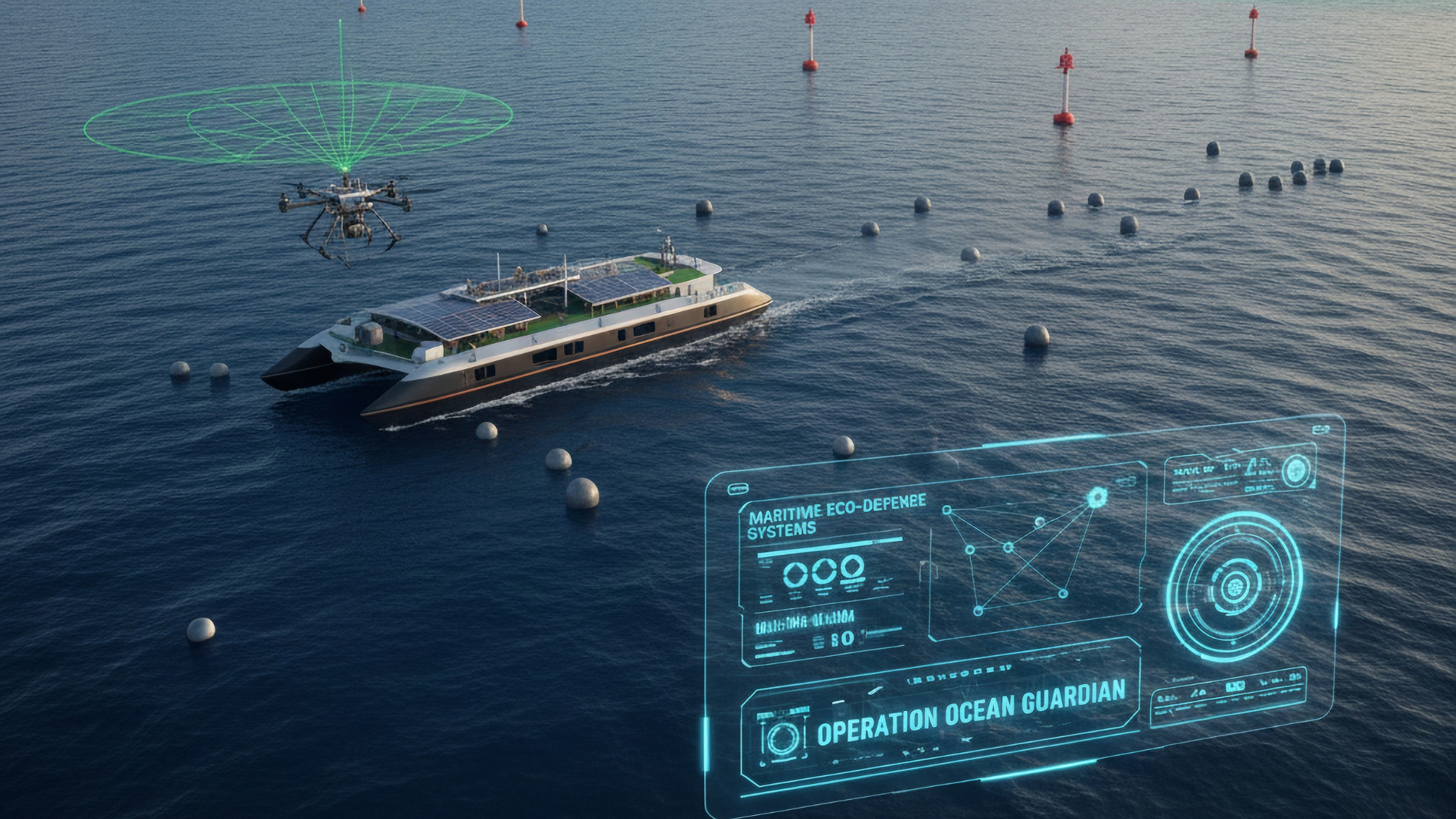
For decades, maritime security has largely been approached through the protection of individual assets: ships, ports, offshore platforms and naval facilities. But recent conflicts have demonstrated that the bigger challenge is protecting the corridor itself – the interconnected network of vessels, infrastructure, trade routes and overall maritime activity that keeps the global economy moving.
The Black Sea has provided a particularly clear example. There, the use of unmanned surface vessels, alongside missiles, mines and other surveillance technologies, has challenged assumptions about how maritime power can be projected and denied.
For GCC nations, the lessons of recent Black Sea operations cannot be directly applied to the Gulf. The geography, operating environment and strategic dynamics involved are very different. However, the conflict has demonstrated how quickly relatively low-cost, unmanned technologies can thoroughly disrupt maritime operations, both commercial and military. The crucial takeaway, therefore, is understanding how important it is to detect, identify and respond to threats before they have a chance to reach critical infrastructure, commercial shipping or military assets.
For the GCC, where some of the world's most important energy and trade routes converge, this shift in threats and counter strategies has particular significance.
From coastal defence to corridor security
While the Strait of Hormuz occupies the strategic thinking of all GCC nations, their collective security challenge extends well beyond the strait itself, encompassing the Arabian Gulf, Gulf of Oman, Arabian Sea and the approaches to all major ports and offshore energy facilities.
These waters form a connected operating environment. A disruption at one point can have consequences far beyond the immediate incident, affecting shipping schedules, insurance costs, energy markets and supply chains.
That means maritime security can no longer be viewed solely through the lens of naval capability. It increasingly depends on maritime domain awareness (MDA): the ability to build an accurate picture of what is happening at sea, identify potential threats and coordinate the appropriate response.
The International Maritime Organization defines a nation or organisation’s MDA around three interconnected capabilities: situational awareness, threat awareness and response awareness. In practical terms, that means knowing what is in the maritime environment, understanding whether something represents a threat, and knowing which resources can respond.
For GCC countries, developing this capability across national boundaries could become one of the most important areas of maritime cooperation.
The underwater threat is harder to see
One of the most significant changes in maritime security is that not every threat is visible from the surface. Unmanned underwater vehicles (UUVs), autonomous underwater vehicles (AUVs), mines and other subsea systems can operate below the waterline, where traditional surveillance systems are less effective. They can be used for reconnaissance, interference with subsea infrastructure or attacks against vessels and port approaches.
This matters because the GCC's maritime infrastructure extends beneath the surface. Pipelines, subsea cables, offshore energy infrastructure and port facilities all form part of the region's critical economic infrastructure. The security problem therefore becomes three-dimensional.
Above the water, authorities may be monitoring commercial traffic, suspicious vessels and aerial drones. At the surface, they need to detect fast-moving or autonomous craft. Below it, they need to understand what is happening around fixed infrastructure and restricted areas. No single sensor can provide that picture.
Instead, future maritime security will depend on combining information from coastal radar, automatic identification systems, electro-optical and infrared cameras, satellites, sonar, acoustic sensors, drones and other sources. The objective should not be simply to collect more data, but to turn multiple streams of information into a common operating picture available to all allied organisations and nations.
Cooperation needs to move from information sharing to operational integration
The GCC already has extensive experience of regional security cooperation. The next step is to translate that cooperation into a more integrated maritime defence capabilities and systems.
International exercises provide one indication of where the region is heading. IMX 2025, held in the Gulf and surrounding waters, brought together approximately 5,000 personnel from more than 30 nations and international organisations, with maritime security cooperation and information sharing among its chief objectives.
Meanwhile, the Joint Maritime Information Center (JMIC) in Bahrain expanded its remit in 2025 to cover the entire Combined Maritime Forces operating area, reflecting a broader emphasis on sharing information and coordinating responses across a geographically connected maritime environment. For the GCC, the opportunity is to build on this principle through stronger regional mechanisms for maritime intelligence, surveillance and (most importantly from a threat deterrence perspective) joint active reconnaissance efforts.
This approach could quickly see new developments and even formal political agreements between GCC nations regarding greater interoperability between national maritime information centres, common procedures for reporting suspicious activity, shared threat databases and more frequent exercises involving coast guards, navies, port authorities, customs, border agencies and critical infrastructure operators.
Whatever the agreed priorities end up being, the strategic objective should not necessarily be for the GCC to develop a single centralised system. National sovereignty and different operational responsibilities will remain important because they allow each partner nation to play to its strengths. However, the agreed systems will still need clear and reliable mechanisms for all partners to communicate with one another when an incident crosses jurisdictions.
This is particularly important for border management. Maritime borders are not static security lines that can be easily defined with walls, gates and guards. Commercial vessels, fishing boats, offshore workers and recreational craft move continuously across a region where territorial waters and economic zones sit alongside some of the world's busiest shipping lanes. A suspicious vessel detected by one country’s waters may become another country's concern within a matter of hours. This necessitates information sharing and clear communication at every level.
Technology will help – but integration is the real force multiplier
Technological aids available to maritime security agencies across the GCC are developing rapidly. Artificial intelligence can help operators identify anomalies within large volumes of vessel and sensor data. Autonomous surface and aerial platforms can extend surveillance without exposing personnel to unnecessary risks. Advanced radar and electro-optical systems can improve detection of small targets, while sonar and acoustic technologies offer new ways of monitoring the underwater environment.
But, like all security challenges we explore at Intersec, relying on technological advances is never the answer. A sophisticated sensor is of limited value if the information it generates remains inside a single agency. Likewise, an AI system that identifies a suspicious pattern of maritime activity is only useful if the organisation receiving the alert has the authority, information and resources to act.
The next generation of maritime security will therefore depend as much on interoperability and command-and-control architecture as on individual pieces of equipment. This also creates a growing cybersecurity requirement. As maritime surveillance becomes a regional rather than national concern, the systems responsible for monitoring vessels, infrastructure and borders become potential targets themselves. Maritime security is consequently becoming an increasingly integrated physical, digital and operational challenge.
Building a resilient GCC maritime corridor
The GCC’s ultimate goal is not to make the region's waters impenetrable. That is neither realistic nor is it compatible with the broader economic ambitions of its respective nations, who would rather focus on encouraging coastal tourism and maritime trade than commit to vast defence spending measures.
The more feasible goal is to make maritime disruption harder to initiate, faster to detect and easier to contain. That requires a layered approach to maritime corridor security, combining persistent surveillance; stronger subsea monitoring; counter-drone capabilities; resilient communications; intelligence sharing; coordinated coast guard and naval responses; and closer integration with commercial ports and shipping operators.
Once in place, this approach also requires regular testing. Exercises should simulate the kinds of ambiguous, multi-domain incidents that security agencies may actually face: an unidentified underwater object near a pipeline, a swarm of small surface drones approaching a port, GPS disruption affecting commercial traffic, or a suspicious vessel moving between jurisdictions. These are all potential threats that GCC nations can realistically expect to face in the future, and ones they must be readily prepared to counter.
These scenarios sit at the intersection of national security, law enforcement, border management and commercial continuity. No single organisation can manage them alone. For the GCC, that makes maritime cooperation more than a defence issue. It is also an economic resilience issue.
The region's ports, energy infrastructure and shipping routes are part of a single economic system. Protecting that system will require a similarly connected approach to security – one that combines national capabilities while creating a clearer regional picture of what is happening at sea.
That is precisely where the convergence of maritime surveillance, border management, counter-drone technology, critical infrastructure protection and national security becomes increasingly important – and where industry and government will need to work closely together to prepare for the next generation of maritime threats.