

When a fire breaks out, every second matters. But the biggest advances in emergency response aren't happening at the scene of an incident, they occur long before the first alarm sounds.
Across the UAE, Artificial Intelligence (AI), predictive analytics and connected technologies are redefining how emergency services anticipate risks, deploy resources and protect both responders and the communities they serve. Recent initiatives by Dubai Civil Defence and Abu Dhabi Civil Defence Authority illustrate a broader shift away from reactive firefighting towards data-driven prevention, where AI can help identify fire hazards before they become emergencies and provide responders with real-time intelligence when every second counts.
As one of the world's leading adopters of smart city technologies, the UAE is demonstrating how digital transformation is becoming an essential component of modern fire and emergency management.
Shifting from reactive response to predictive protection
Traditional firefighting has always depended on rapid response. While response times remain critical, today's emergency services are more focused on preventing incidents from escalating in the first place.
This shift is powered by the convergence of AI, the Internet of Things (IoT), cloud computing and advanced analytics. Connected sensors in buildings, industrial facilities and critical infrastructure generate vast amounts of operational data, allowing emergency services to identify anomalies that may indicate developing fire risks.
Dubai Civil Defence has already demonstrated the potential of predictive intelligence through AI-powered systems capable of analysing fire safety data from buildings across the emirate. By identifying patterns and potential hazards before an incident occurs, these systems support earlier interventions and more targeted inspections, helping to reduce both the likelihood and severity of fires. Thanks to the DCD, thousands of buildings in Dubai are now equipped with small devices that monitor fire risk in real time.
Instead of relying solely on alarms triggered after a fire has started, predictive systems analyse patterns in environmental conditions, equipment performance and historical incident data to identify potential fire hazards before an emergency occurs. These insights allow building operators and emergency authorities to intervene earlier, reducing both the likelihood and severity of incidents.
For firefighters, this means arriving at an incident with far greater intelligence than ever before.
AI-powered command centres are enhancing decision-making
Emergency command centres are evolving into sophisticated digital hubs where information from multiple sources is combined into a single operational picture.
AI-enabled platforms can aggregate data from building management systems, CCTV, weather services, traffic networks, emergency calls and connected fire detection systems in real time. Rather than overwhelming operators with raw information, intelligent software helps prioritise alerts, recommend response strategies and identify the fastest deployment routes.
The UAE is investing heavily in these capabilities. In late 2025, Dubai Civil Defence partnered with Dubai AI Campus to establish the Civil Defence AI Lab, a collaborative initiative focused on accelerating AI applications for firefighting, rescue operations and public safety. The lab brings together emergency services, researchers and technology partners to develop solutions that improve operational readiness and strengthen public safety.
Meanwhile, Abu Dhabi Civil Defence Authority has partnered with AI company Presight to develop intelligent emergency response capabilities, including predictive dispatch, dynamic route optimisation, risk mapping and real-time emergency simulations. Their collaborative goal is to help emergency services move beyond responding to incidents towards anticipating them through data-driven intelligence.
By transforming command centres into intelligent decision-support environments, emergency services can respond more effectively to complex incidents while improving coordination across multiple agencies.
Drones are becoming an essential emergency response tool
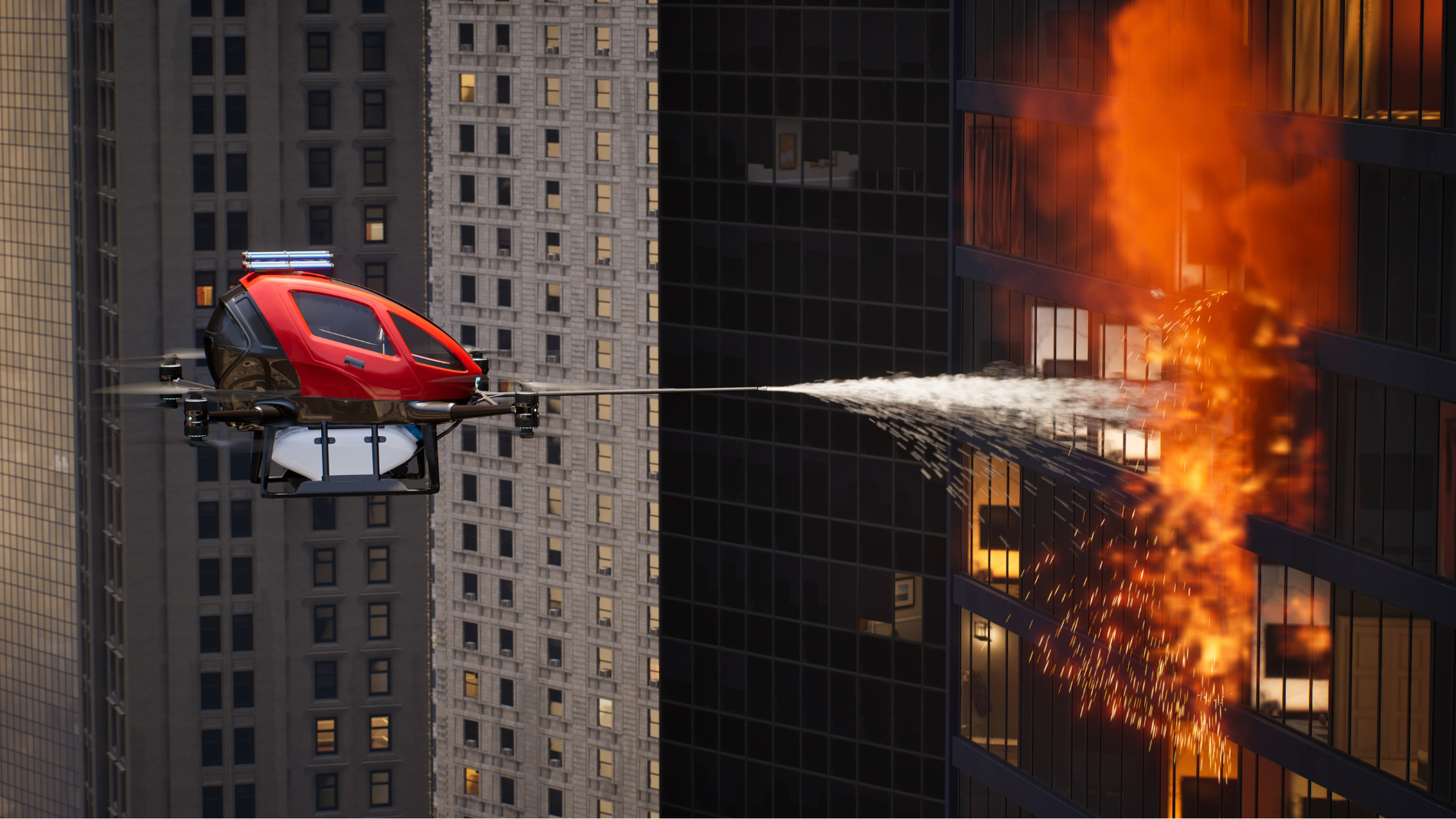
One of the most significant developments in recent years has been the operational use of drones during live incidents. Equipped with thermal imaging cameras, high-resolution video and environmental sensors, drones can rapidly assess fires from above, identify hotspots hidden beneath smoke, monitor structural damage and search for trapped occupants without placing firefighters in unnecessary danger.
Dubai Civil Defence has already demonstrated how these capabilities translate into real-world outcomes. During a residential tower fire in Al Barsha, its Shaheen firefighting drone system supported suppression efforts by delivering water and firefighting foam to areas that would otherwise have been difficult and dangerous to reach. The deployment highlighted how unmanned aerial systems can complement traditional firefighting techniques, particularly in dense urban environments and high-rise buildings.
Beyond active firefighting, drones are also supporting post-incident assessments, wildfire monitoring and infrastructure inspections, providing emergency services with faster, safer and more comprehensive situational awareness.
Automation is improving firefighter safety
Automation is no longer limited to specialised robotics. Increasingly, intelligent systems are supporting firefighters throughout the entire emergency response lifecycle.
Wearable technologies can monitor firefighter health and environmental conditions in real time, alerting incident commanders to signs of heat stress or dangerous levels of toxic gases. Smart equipment tracking ensures critical resources remain accounted for during complex operations, while AI-assisted training platforms create realistic virtual scenarios that prepare responders for extremely challenging emergencies.
Digital twins – virtual representations of buildings and infrastructure – are also emerging as valuable planning tools. By integrating live sensor data with detailed building models, emergency services can better understand evacuation routes, hazardous material locations and structural layouts before crews arrive on site.
The result of adopting greater automation of firefighting approaches and overall operational planning is not simply faster response times, but safer, more informed operations that protect both the public and the firefighters themselves.
Building resilience through intelligent fire protection
The UAE fire safety and protection market is projected to reach over $1.2 billion by the end of 2026, but this figure is only part of a much broader evolution in emergency management. Smart buildings, intelligent fire detection, predictive analytics, connected command centres and autonomous systems are no longer isolated innovations – they are becoming part of an integrated ecosystem designed to improve resilience across entire communities.
For organisations responsible for protecting people, property and critical infrastructure, the message is clear: emergency preparedness is becoming increasingly data driven.
The future of emergency response will not be defined by a single breakthrough technology, but by how effectively AI, connected sensors, predictive analytics, drones and intelligent command platforms work together. As buildings, infrastructure and cities become smarter, fire protection must evolve with them.
For organisations across the UAE and beyond, investing in digital readiness is no longer simply an innovation strategy, it is becoming a core requirement for operational resilience. Those that can harness data effectively, integrate intelligent technologies and empower responders with real-time insights will be better prepared to help the UAE manage its complex fire risk landscape. These themes are expected to feature prominently at Intersec Global, where industry leaders will explore how digital innovation is helping emergency services and fire safety professionals prepare for the risks of tomorrow.