

The GCC has spent decades building some of the world's most advanced urban environments. From futuristic skylines and industrial mega-projects to expanding transport networks and smart city initiatives, the region has become synonymous with rapid development and innovation. Yet alongside this transformation, a new set of risks is emerging.
Climate change is no longer a distant environmental concern. Some parts of the region could face up to 200 days of exceptional heat per year on average by the end of this decade. Rising temperatures, increasingly unpredictable weather patterns, rapid urbanisation and industrial expansion are fundamentally changing how governments and emergency services must think about resilience. Fire safety remains a critical priority, but emergency preparedness can no longer focus solely on preventing and responding to fires. Today's risk landscape is broader, more interconnected and increasingly complex.
For GCC cities, it’s not a matter of preparing for a theoretical climate-related emergency, but a near-inevitable reality.
A changing risk landscape
The Middle East is warming at nearly twice the global average in some areas, bringing more frequent heatwaves and placing growing pressure on infrastructure, energy systems and emergency services.
Meanwhile, cities continue to expand. High-rise developments, mixed-use communities, logistics hubs, ports and industrial facilities are increasing both the density and complexity of urban environments as GCC cities try to achieve their full potential as global logistics hubs. Population growth further amplifies demand on emergency responders, as the GCC population is projected to rise to 83.6 million by 2050, representing an annual population growth rate of 2.8%, nearly three times the global average. The concentration of critical infrastructure needed to support this growing (and increasingly concentrated) population means that even relatively localised incidents can have far-reaching consequences.
There are also new operational challenges to consider. Extreme heat can increase the likelihood of equipment failures, place additional strain on firefighters and rescue personnel (particularly their physical and mental health), and complicate evacuation efforts. Industrial growth introduces more hazardous materials into urban environments, requiring specialist response capabilities that extend well beyond traditional firefighting.
Taken together, the onset of climate-related emergencies and more challenging conditions in general requires GCC governments and emergency responders to adapt quickly before they are caught flat-footed.
Lessons learned from extreme weather
Historically, much of the GCC has been considered relatively insulated from the kinds of severe weather events experienced elsewhere. That assumption is changing.
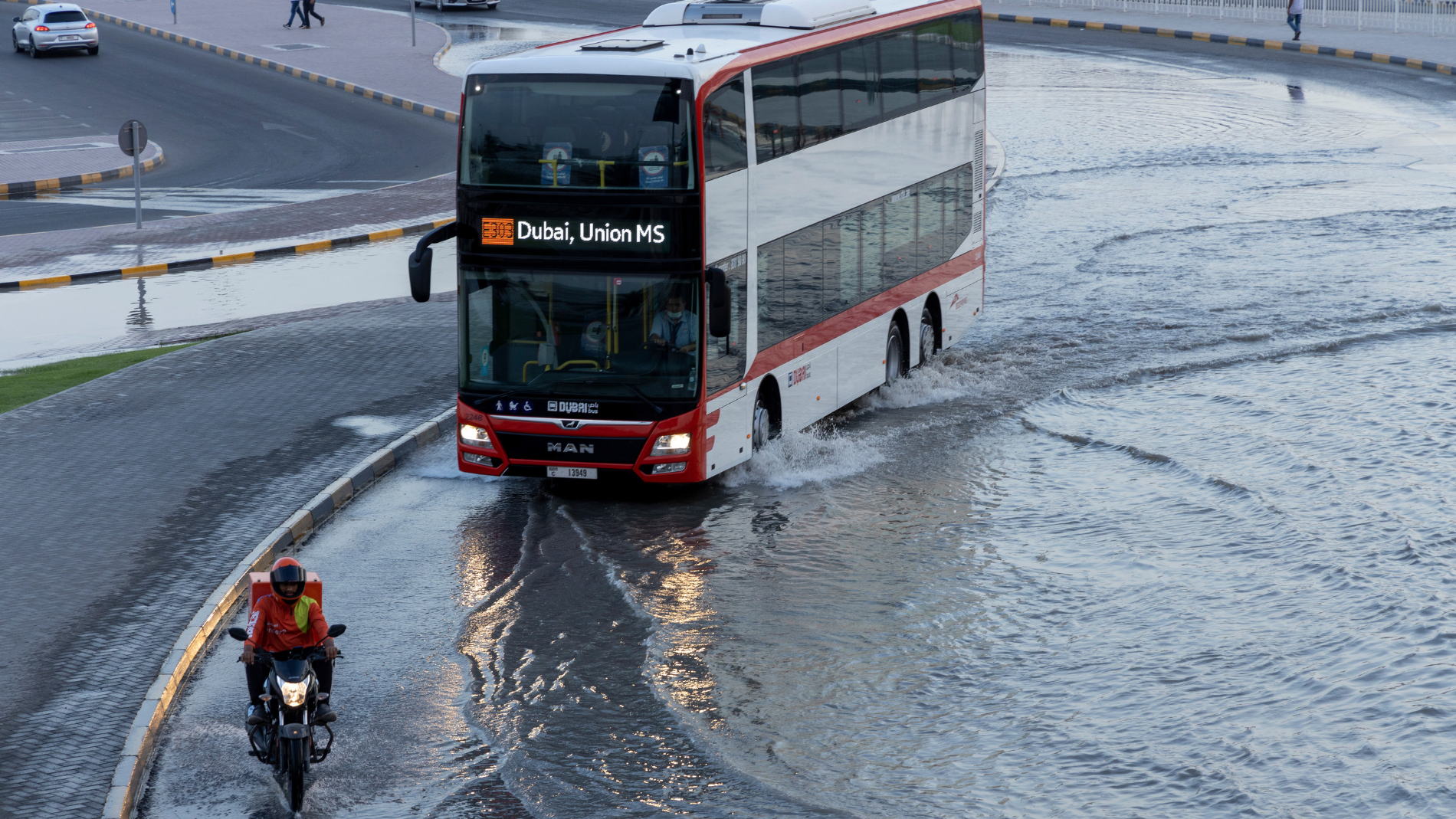
The unprecedented rainfall that affected the UAE in April 2024 demonstrated how quickly climate-related incidents can overwhelm infrastructure and emergency response systems. Flash flooding disrupted airports, roads, schools and businesses, requiring multiple agencies to coordinate rescue operations, traffic management, public communications and infrastructure recovery simultaneously. In the same month, heavy rains in Oman killed at least 18 people, demonstrating the tragic cost in human life as well as damages to livelihoods the built environment.
While such events remain relatively rare, they may become more common in the GCC. Even so, they highlight an important reality: emergency planning cannot rely solely on historical patterns. Freak occurrences related to climate may become less exceptional as our shared global climate continues to change.
Accordingly, GCC cities’ preparedness must account for low-frequency but high-impact events. Flash floods, severe storms, prolonged heatwaves and cascading infrastructure failures all require integrated planning across government agencies, emergency services and private sector operators.
Rather than responding to one hazard at a time, organisations must prepare for incidents where multiple risks occur simultaneously.
Beyond firefighting: Building all-hazards resilience
Traditional emergency planning has often been organised around specific scenarios – fire response, hazardous materials, medical emergencies or civil defence. However, climate resilience requires a broader approach.
An all-hazards model (such as the UAE framework for Global Climate Resilience) recognises that many emergencies share common operational requirements, regardless of their initial cause. Effective communication, real-time situational awareness, interoperable command systems, resilient equipment and coordinated decision-making become essential across every type of incident.
This shift also places greater emphasis on prevention and preparedness. Risk assessments need to consider climate projections alongside existing hazards. Infrastructure should be designed with resilience in mind, incorporating flood mitigation, heat-resistant materials and redundancy for critical systems. Regular multi-agency exercises can help identify operational gaps before real emergencies occur.
Technology is also playing an increasingly important role. Digital command platforms, connected sensors, drone-based reconnaissance, predictive analytics and AI-assisted decision support are enabling emergency responders to build a more comprehensive picture of evolving incidents, helping leaders make faster, better-informed decisions.
National strategies for increasingly complex emergencies
Every GCC government has already recognised that climate resilience requires a coordinated, national approach rather than isolated emergency planning. While each country is at a different stage of implementation, several have launched dedicated strategies that combine climate adaptation, infrastructure resilience and emergency preparedness.
The UAE has positioned resilience as a central pillar of its National Climate Change Plan 2017–2050, complemented by the National Climate Change Adaptation Programme and a federal climate law introduced in 2024 that requires adaptation planning across sectors. Following those record-breaking floods of April 2024, authorities accelerated investment in flood resilience, with Dubai approving an AED 30 billion (US$8.2 billion) 'Tasreef' stormwater drainage programme (Phase 2 began in February 2026), one of the region's largest infrastructure projects designed to significantly expand the emirate's capacity to manage extreme rainfall events. In April 2026, Dubai Municipality confirmed that Tasreef will be completed by the end of 2027, increasing drainage capacity by 700% in 13 areas of the emirate.
In Saudi Arabia, climate resilience forms part of the wider Saudi Green Initiative (SGI), which integrates environmental protection with national development and civil resilience. Since its launch in 2021, the programme has introduced more than 85 initiatives spanning afforestation, emissions reduction, water security and ecosystem restoration. At the regional level, Saudi Arabia has also committed US$2.5 billion to support the Middle East Green Initiative, strengthening climate resilience and environmental cooperation across the wider region.
Qatar has adopted one of the region's most comprehensive planning frameworks through its National Environment and Climate Change Strategy (2021) and accompanying National Climate Change Action Plan, which contains more than 300 adaptation measures covering water security, critical infrastructure, coastal protection, public health and emergency preparedness. While investment is delivered through multiple national programmes rather than a single resilience fund, the strategy embeds climate adaptation across government planning and infrastructure development.
Oman is integrating resilience through its National Strategy for Adaptation and Mitigation to Climate Change (2020–2040) and broader Net Zero 2050 agenda. The strategy focuses on strengthening water resource management, protecting critical infrastructure, improving public health resilience and embedding climate risk into long-term development planning, ensuring emergency preparedness becomes part of national infrastructure investment rather than a standalone activity.
In Kuwait, the National Adaptation Plan (2019–2030) identifies priority investments across water management, land use, healthcare and infrastructure resilience. The plan is notable for assigning sector-specific budget requirements to adaptation measures, helping translate climate risk assessments into practical implementation programmes across government.
Meanwhile, Bahrain has developed a National Adaptation Investment Plan (NAIP) that prioritises coastal resilience, flood management, water security and disaster risk reduction. The programme complements Bahrain's longer-term sustainability agenda under Vision 2030, recognising that protecting rapidly urbanising coastal communities requires closer coordination between infrastructure planning and emergency response agencies.
Taken together, these initiatives signal an important shift in how the GCC is approaching emergency preparedness. Rather than focusing solely on responding to individual incidents, governments are increasingly embedding resilience into national planning, infrastructure investment and climate policy. As extreme weather events become more frequent and urban environments grow more complex, success will depend not only on stronger response capabilities but also on the ability of governments, emergency services and the private sector to operate as a single, coordinated resilience ecosystem.
Preparing for tomorrow's risks
The GCC has consistently demonstrated its ability to anticipate future challenges and invest in long-term solutions. Climate resilience presents another opportunity to demonstrate its leadership and reassure both citizens and visitors that the threat of climate change is being taken seriously.
Preparing for tomorrow's emergencies will require continued investment in specialist rescue capabilities, disaster response equipment, digital command technologies and workforce development. It will also demand stronger partnerships between governments, emergency services, infrastructure operators and technology providers.
As climate risks evolve, so too must emergency preparedness. Success will not be measured simply by how quickly organisations respond to disasters, but by how effectively they anticipate emerging threats, coordinate across sectors and strengthen resilience before incidents occur. Equally, as governments strengthen their resilience strategies, collaboration across the emergency management ecosystem will be essential. Bringing together policymakers, first responders, infrastructure operators and technology innovators, Intersec Global reflects the growing emphasis on integrated approaches that help communities prepare for an increasingly complex and unpredictable risk landscape.